Bespoke Suits in Toronto
Here at Philip Sparks Tailored Goods Inc., we have been tailoring suiting since 2007. Every bespoke suit is made just for you in our Toronto studio. The pattern, the cut, the design and the fabric selection have no limits. We can fit all body types regardless of gender. If you are looking for something traditional, dandy, formal, rugged or period inspired, we have hundreds of fabric options from the world’s best mills that are updated seasonally. We also stock a selection of vintage cloth and horn buttons. The choices can seem overwhelming, but we’ll take the time to walk you through it and help you make the best choices for your suit.
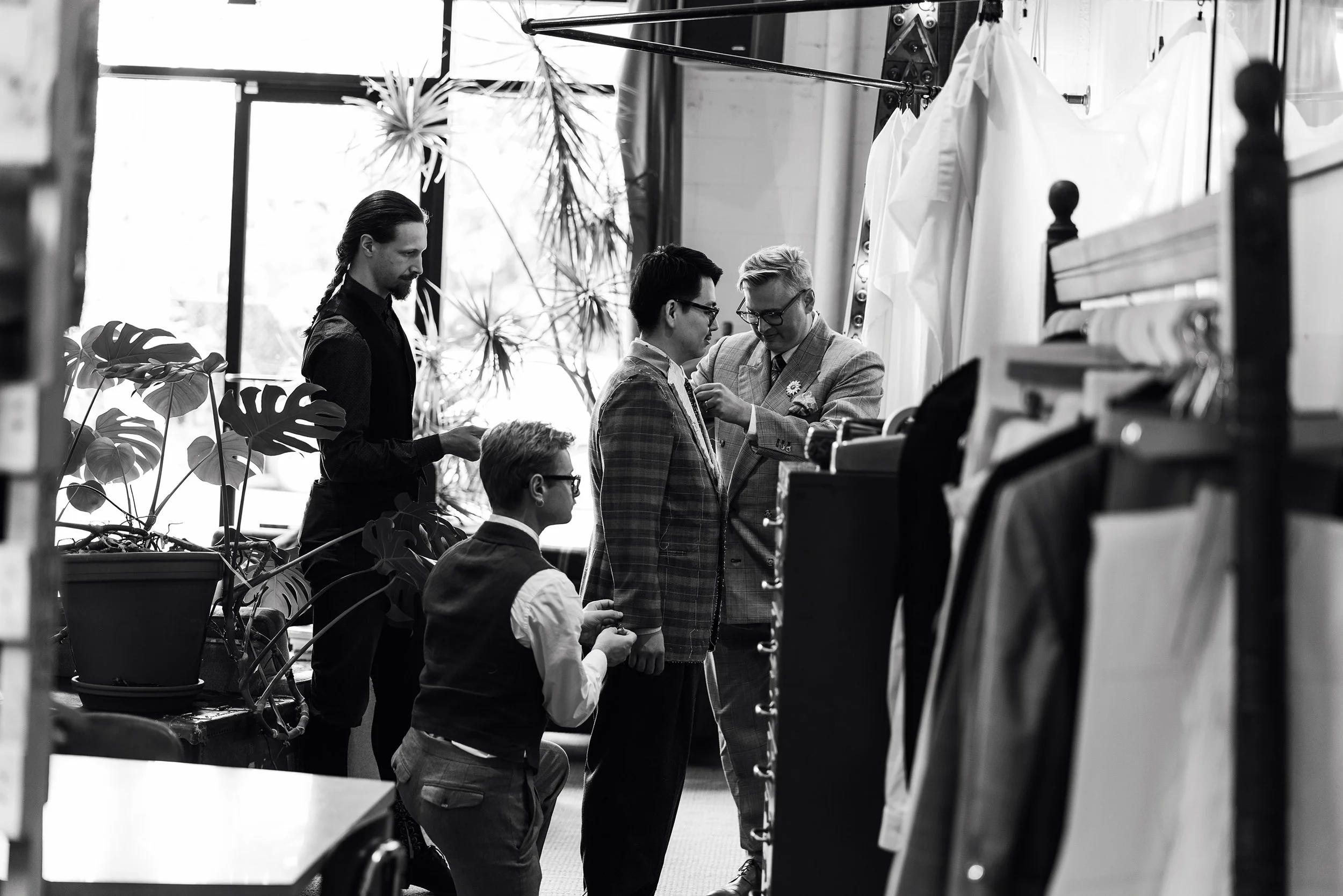
Bespoke suit fitting at the Philip Sparks Toronto tailoring studio
What Makes a Suit Bespoke?
In bespoke tailoring, the person taking your order and measuring you is the person developing your pattern, fitting your suit and managing the making of it. The fit of a bespoke suit is found through a series of fittings, where the suit is adapted to your body, your proportions and your preferences. A bespoke suit includes significant hand work, including a hand sewn gore line and neckline, and features surgeon cuffs. Bespoke suits are fully canvased and have been made with extra inlays and larger seam allowances for future alterations. In a consultation for a bespoke suit, you should be able to choose from a large range of fabrics, including bringing your own if you have it. A bespoke suit can incorporate any style or detail request.
Designing Your Bespoke Suit
It is our goal to create custom tailored garments that make you feel comfortable and confident. We make everything in house from scratch, which means we can make almost any tailored garment you can think up. There are no set menus that you have to choose from. Our team will walk you through the process to design a garment around you, your personal style, body and fit preferences. Our consultation space opens directly into our workroom so you can see tailoring in progress while exploring ideas for your wardrobe.
Browse our fabric library, tailoring detail boards, sample jackets, tuxedos, neckties, pocket squares, eye-wear, works in progress and inspiration boards while discussing your bespoke suit.
Bespoke Suit Fabrics
We have an exceptional fabric library of stock materials from Italian, British, Swiss, Japanese and, most proudly, Canadian mills. We call our library the Ruby Room. We also have an extensive collection of fabric books from premium global suppliers including Drapers, Batemen Ogden, Fox Brothers, Loro Piana, Dugdale, Wave Fibre Mill and many more. Materials like linings and buttons, including horn and mother of pearl options, are chosen when they can be placed on or in a garment in actual cloth so you can see how they change the look of the final piece.
Over 100 Hours of Work
There are over 100 hours involved in making a bespoke suit. Patterns are made and adapted for you specifically. A bespoke suit is basted together for a fitting and then completely taken apart to make adaptations before being reassembled to a greater level of construction and taken apart again. This labour-intensive process of assembling and disassembling is how the perfect fit of a suit is achieved. Only once we have perfect proportions and preferences is a bespoke suit then hand sewn closed, button holes cut and buttons sewn onto the final garment. Finished bespoke suits are made with extra inlays or larger seam allowances so that alterations can be made in the future extending the life of a garment for you.
Bespoke Suit Construction
-
A full, hung canvas is hand sewn into a jacket, not glued. It structures the chest and shoulders, forms the natural roll of a lapel and runs the full length on the front of a coat. A full canvas supports a clean, unstretched front edge of a bespoke jacket. It prevents buttons and button holes from stretching out and it also supports pocket openings. A full hung canvas is basted into a suit jacket during its construction. It is done with roundness and is usually the reason you see most of the white threads, or basting stitches, on a bespoke jacket as it is being constructed. Throughout various fittings and construction, the canvas is slowly hand stitched with its roundness at its outer edges to the jacket and, at its completion, the basting stitches that helped to ensure the canvas was put into the jacket body smoothly will be removed. A canvas constructed in this way will last for a long time. It will continue to mould and shape to your body as you wear it and it will not bubble and separate like a canvas that has been fused or glued in. Want to learn more about canvas types and construction? Visit our Youtube channel.
-
Surgeon cuffs are functional buttons on the sleeves of a jacket. In many made-to-measure and off-the-rack suits, these are decorative only. They are made decorative so that the sleeve length can be adjusted for the final customer. In a bespoke suit, we are establishing exactly the right sleeve length for you during our fitting process, which means we can actually cut the button holes and make them functional without risking an incorrect sleeve length. A made-to-measure suit usually has these features already completed the first time you try it on.
The name “surgeon cuffs” is a Victorian tailoring term. As a surgeon’s vocation became recognized as a higher class pursuit, they earned the right to wear suits and did so proudly, unbuttoning and rolling up their sleeves in order to perform surgery. Today, surgeon cuffs are a marker of high end bespoke pieces. Wear your jacket with the bottom sleeve cuff button undone so those who know, will know.
-
Look inside your jacket at the lining around the armhole. In a bespoke jacket, you should be able to make out tight and tiny slip stitches that are done by hand. This is done so the lining can be controlled and set in with just the right amount of looseness in the length and width of the garment so that it doesn’t pull over time on the outside of the jacket. It is also done in this way to attach the lining at the armhole to the canvas and through to the body of the garment. These meticulous stitches and all of the layers that they hold together make it easier to put your arm into the sleeve of a jacket and keep the layers in place while you are wearing the piece. They also serve to hold the structure of canvas and padding firmly in place for the life of your garment. Watch this video of one of our tailors hand sewing the armhole on a bespoke jacket. Learn more about sleeves styles on our Youtube channel.
-
The gore line is the neckline of the jacket where the collar and the lapel meet. The shape and height of this line can vary by design. In bespoke suits, the gore line is stitched together by hand, invisibly. This is done by hand so that we can very closely control exactly how much extra cloth the top collar needs to roll over top of the undercollar of French canvas and felt. The height of the stand on the collar and thickness of the cloth is going to change from suit to suit. This hand-sewn process ensures that the collar lays smooth and flat to the jacket body and doesn’t curl away its front. Two types of stitches are done here. The first row is to hold the lapel fabric to the collar fabric and the second row secures the gore line to the canvas and layers of construction underneath.
-
In order to offer a starting price point that is more accessible to customers, we offer machine-made button holes that are completed using our vintage Reece 101 keyhole buttonhole machine. We also offer hand sewn button holes that really elevate a piece. Hand sewn buttonholes produce a higher raised ridge of chain stitching along their edge and produce a clean inside edge of the buttonhole where no raw fabric or canvas can be seen. We also offer other decorative, hand-sewn button holes like a Milanese buttonhole. A Milanese buttonhole is usually produced on a lapel and used for things like boutonnieres. Milanese buttonholes differ from regular button holes in two ways. Milanese buttonholes aren’t usually made to accommodate a button so they don’t have the larger keyhole shape seen at one end of regular buttonholes. They are also produced with a different stitch creating a raised edge along the button opening, but in a smoother, almost satin-like finish that can be a great finishing touch on a jacket.
-
We offer prick stitching. This can be done in a variety of areas on a suit instead of machine stitching. Prick stitching is intentionally visible hand stitching, most commonly seen along the front edge lapel and collar of a bespoke jacket, but sometimes also along or around pockets and pocket openings and on some seams. This technique highlights the handwork that is performed on a piece, making the craftsmanship that has gone into a bespoke suit more noticeable. Check out this Video of Takuma, one of our tailors prick stitching the top edge of a breast welt pocket.
The Bespoke Suit Process
-
Every bespoke suit starts with our consultation. Our tailors will ask about what you need your suit for, and what some of your general preferences and concerns are. After this briefing, a consultation usually moves on to looking through material. Your choice of fabric can help us narrow down details and how they might best be used. After narrowing down cloth options, our consultation will turn to design elements and the cut of your suit. Once we have defined your style, selected fabric, considered details and provided a quote, we will take your measurements and book the first of four fittings. Expect the bespoke suit consultation to take approximately one hour, and allow 8 to 12 weeks for the completion of the suit. A deposit of 50% will be taken to start with the balance due when your pieces are complete. From here, our tailors will start drafting patterns for your pieces. If your timelines are tighter, we’re always open to considering a quicker turnaround.
-
The mock-up of your bespoke suit in a test material is a unique and important part of our shop’s process. It allows us a physical form of communication before actual cloth is cut and details become more concrete. You will be able to see and try on a rough draft of what we discussed at our consultation. It’s a chance for our tailors to work through technical fit, but also adapt proportions to your body. It’s also a chance for you to see and try details that you might be unsure of. It is not in the real cloth so major changes can still be made.
-
Your tailor will take the changes identified in your mock-up fitting and adjust your patterns based on these notes. Our first fabric stage is created in the final cloth but still in the rough. Sleeves have not yet been attached to the jacket, leaving the shoulders open for us to fine tune adjustments like padding and asymmetry of the body. Sleeves are hung in the fitting to the angle of your arm. Finer adjustment to length, waist suppression (how fitted or loose you prefer the shape of your suit) and lapel shape can still be made at this stage. It’s in the first fabric fitting that we choose things like lining and buttons that can change the look and feel of suit.
-
At this stage, your bespoke suit is starting to look like a finished garment and you can really see how it has come together. The sleeves are set, the collar and lapels are attached and linings have been put in. There is still a chance at this stage for us to get back inside and make small tweaks before the whole suit is hand-sewn closed, button holes are set and buttons are sewn on. Overall, this fitting is focused on ensuring there’s a sense of harmony in all of the suit’s elements.
-
You can expect to take home your bespoke suit after our final fitting. Here, you are trying on the finished piece. There is sometimes some back and forth between our irons and your body to get the final moulding perfect, and we make sure the hem of your trousers aligns with the shoes you plan to wear most often
Bespoke Suit FAQs
-
After your initial consultation, expect approximately four fittings throughout the bespoke process, from the mock-up through the final fitting.
-
Around 8 to 12 weeks from first consultation to final fitting, across roughly four appointments. More time is required for more complicated designs and during our busy season from March to September. If your order is more rushed, it never hurts to reach out.
-
Our tailoring style has been described as a uniquely Canadian blend of British, French and American styles of tailoring. We predominantly build suits with a strong shoulder and structure in the chest, a nipped waist with some drape at the shoulders, and cut narrow at the hips for a Y-shaped silhouette.
Our house style is a starting point rather than a limitation. We can and do cut in a wide variety of styles, with varying amounts of padding and canvas construction and sleeve styles, including Italian, or Neapolitan-style, tailoring with softer shoulders and flat sleeve crowns.
We also cut in a wide range of historical silhouettes and have worked with many clients on creating a unique style just for them. Check out our Talking Tailoring series on our blog and website, where we talk through the differences between many of these design and construction approaches.
-
Bespoke suits are ordered by and made for an individual. At Philip Sparks Tailored Goods Inc., bespoke suits are made onsite at our Toronto tailoring studio. Your measurements are taken by the tailor responsible for your fittings, drafting your patterns and managing the making of your pieces. They are meticulously fitted to the body, requiring upwards of 100 hours to produce each suit and multiple fittings. Jackets are constructed with a full, hung canvas, surgeon cuffs, hand-sewn armholes and gore line. We discuss the construction of our jackets, including different approaches to canvases and sleeves, in our Talking Tailoring series.
A truly bespoke fit is developed over at least four fittings. At Philip Sparks Tailored Goods Inc., we start with a mock-up in a test material, a less common but valuable step in the bespoke world.
There are no legal definitions of bespoke, so the term can be confused by other firms offering services like “Modern Bespoke” or “Contemporary Bespoke,” which may actually be made-to-measure services with varying levels of canvassing and hand finishing.
To make sure you are getting a truly bespoke piece, ask to see the workroom, ask to see work in progress—not just finished garments—and ask how many fittings will be involved.
-
The biggest difference between bespoke and made-to-measure is the level of customization and time dedicated to creating a garment.
A bespoke piece should be created on site by building on and adapting to your body, proportions and preferences over a series of fittings.
With made-to-measure, you are typically trying on and tweaking a finished garment manufactured offsite.
Our definition of bespoke
Bespoke suits are ordered by and made for an individual. At Philip Sparks Tailored Goods Inc., bespoke suits are made onsite at our Toronto tailoring studio. Your measurements are taken by the tailor responsible for your fittings, drafting your patterns and managing the making of your pieces. They are meticulously fitted to the body, requiring upwards of 100 hours to produce each suit, and multiple fittings. Jackets are constructed with a full, hung canvas, surgeon cuffs, hand-sewn armholes and gore line. We discuss the construction of our jackets, including different approaches to canvases and sleeves, in our Talking Tailoring series.
A truly bespoke fit is developed over at least four fittings. At Philip Sparks Tailored Goods Inc., we start with a mock-up in a test material, a less common but valuable step in the bespoke world.
How made to measure is different
Made-to-measure is when a tailoring firm is provided with style books or samples and a selection of cloths from a larger manufacturer. The customer then makes selections from a menu of options.
This quote from The Men's Clothing Industry, published in 1970, paints a good picture of made-to-measure tailoring:
“The tailor merely acted as a sales agent. He took measurements of his customer who selected the fabric, sent this information to the tailoring house located in a distant city, and delivered the finished garment to the customer when it arrived from the factory.”
As you are trying on finished garments at a made-to-measure fitting, only minor alterations are possible. There are also more limitations in the design of made-to-measure, as firms are working from patterns that have already been developed and graded (made into different sizes), as opposed to developing patterns for an individual, as is the case in bespoke.
Other terms
There are no legal definitions of bespoke, so the term can be confused by other firms offering services like “Modern Bespoke” or “Contemporary Bespoke,” which may be made-to-measure services incorporating varying levels of canvassing and hand finishing.
What questions to ask
To make sure you are getting a truly bespoke piece, ask to see the workroom, ask to see work in progress – not just finished garments – and ask how many fittings will be involved.
-
Yes, we make bespoke suits for women, men, trans and non-binary people. We can cut for all body types and all genders regardless of fit and design preferences.
-
Yes, most consultations start with browsing our Ruby Room stock fabric library and our books of fabric options that can be brought in from international mills. If you have a special piece of cloth you’ve purchased on you own, we can make your pieces using it. We also have options for custom woven fabrics.
-
Yes, our tailors will walk through all of the details with you. Expect to discuss jacket shape and button structure, single breasted, double breasted, one, two or three buttons and more. We will talk through a variety of gore line heights and lapel shapes but can accommodate any style. Shoulder structure, sleeve style and canvasing are adaptable. Trouser rise, width, flat front and any pleat variation are all possible requests. Pockets and stitching details, linings, special trims, silk lapels and bindings are all details that can be discussed with your tailor. Don’t get overwhelmed and feel like you have to do a lot of research on all of these elements before you come in. We can guide you through the process. If you arrive with something very specific in mind, we will be happy to make it in collaboration with you.
-
Yes, our background in costume means we are well versed in cutting a variety of period shapes including 17th century, Victorian, Edwardian, early-to-mid-20th century and other historical silhouettes. Ask our tailors about your period interests.
-
All of our bespoke suits are made in our Toronto tailoring studio in Toronto’s west end, in the Junction neighbourhood just north of Dundas West and Keele. When you visit our shop, you can see right into our workroom and see our tailors at work.
-
The cost of a bespoke suit varies depending on the fabric, construction, design details and scope of the commission. We provide a quote after your consultation once we understand what you would like to create. A two piece bespoke suit (jacket and trousers) starts at $4,700. A 50% deposit is taken when you place your order, with the balance due when your pieces are complete.
Bespoke Suits at a Glance
Location: Toronto
Services: Bespoke suits, vests, trousers, skirts, Norfolk suits and overcoats.
Clients: Any body, all genders.
Timeline: Approximately 8 to 12 weeks from consultation to final fitting, across four fittings.
Consultations: By appointment, complimentary at our Toronto studio.
Cost: Bespoke suits vary widely. The final cost of your suit will reflect material choices, details, timelines and other elements we discuss during your first consultation. A two piece bespoke suit (jacket and trousers) starts at $4,700. A 50% deposit is taken when you place your order, with the balance due when you pick up the finished suit.

Quisque iaculis facilisis lacinia. Mauris euismod pellentesque tellus sit amet mollis.