Shirts are one of the most versatile garments in a wardrobe, but the history of the shirt is much more complicated than it first appears. From formal dress shirts and tuxedo shirts to camp shirts, work shirts and blouses, the shirt has evolved into countless styles and forms. In this article we explore the history of shirt styles, the details that define them, and how those ideas can be interpreted through bespoke shirtmaking.
In case you missed our shirting workshop, here is a recap of what we covered.
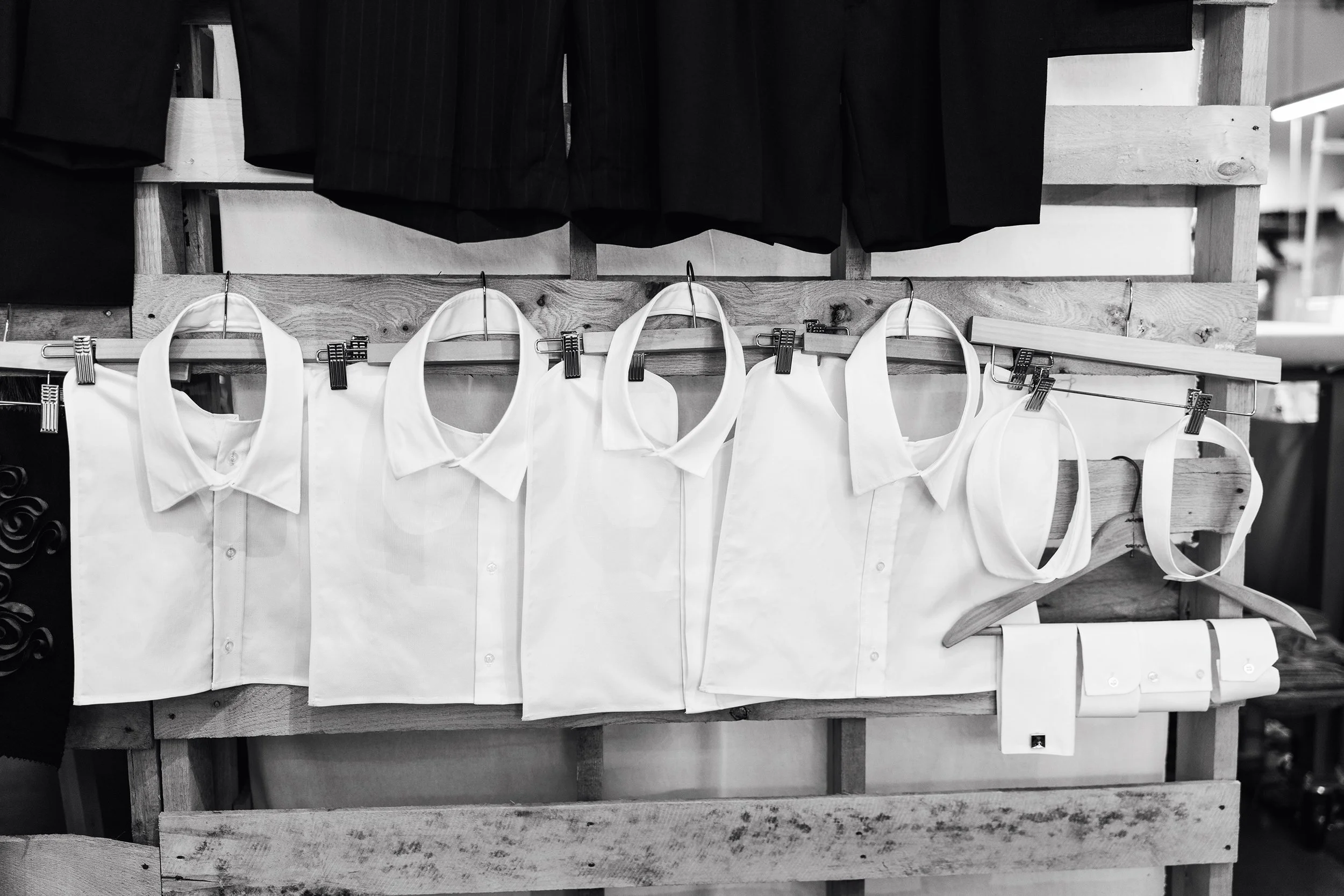
Bespoke shirt detail samples at Philip Sparks Tailored Goods
The History of the Shirt
We spoke of the history of a dress shirt, a garment that is worn next to the skin, as something that started as an undergarment made from a fibre (linen or cotton) that is more easily washed and cared for. We discussed how shirts started to peek out from undergarments and how they were embellished with embroidery and lace, details that still evoke intimacy in undergarments today.

Arnold, J., Levey, S. M., Tiramani, J., Passot, S., Thornton, C., & Tomaszewski, P. (2023). Patterns of fashion 4: The content, cut, construction, and context of linen shirts, smocks, neckwear, headwear and accessories for men and women c.1540-1660. The School of Historical Dress.
I spoke of the challenges of fitting a shirt and how it being worn next to the skin means more attention needs to be paid to asymmetry in the body. Shirts are not usually padded or canvassed like a jacket.
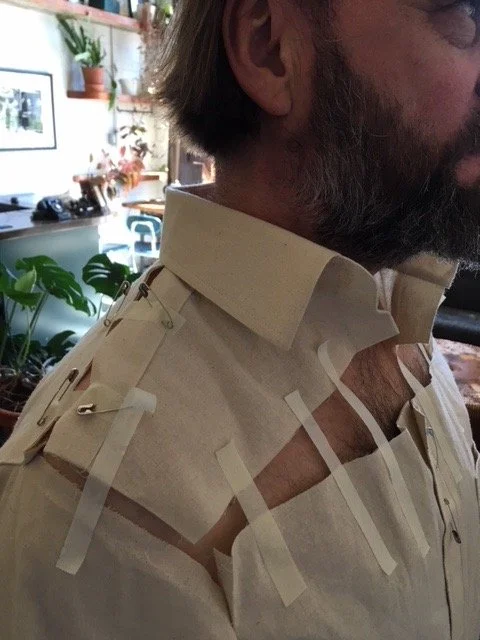
A muslin shirt fitting at the Philip Sparks studio
How Shirt Styles Have Changed
We also talked about dress shirts today and the variety of styles and uses that they evolved from, starting with what may be one of the most classic dress shirt styles today, the Oxford shirt. This shirt was developed for polo players. The collar buttons down so that it doesn’t pop up while players are active in the sport and it is made from a more durable cloth referred to today as Oxford cloth. An Oxford cloth is a fabric with a basket weave that allows the yarns to be compressed tighter, producing a denser, stronger cloth. When it’s not white, Oxford cloth is always a yarn-dyed cloth with the warp yarns most commonly being in white and the weft or filling yarns being in the colour of the cloth. This produces more of a depth to the overall colour.

A pair of bespoke “oxford” shirts with the shirt on the left being made with a chambray and the shirt on the right being made with an oxford cloth. Made in the Philip Sparks Toronto Tailoring Studio
Oxford shirts, Oxford cloth and Chambray
While we are on oxfords and a more durable cloth, we also spoke about work shirts and chambray. You might ask how a chambray differs from an oxford cloth? The simplest answer is that it’s not a basket weave but a plain weave. It's usually the warp yarns that have been dyed a colour, usually a darker indigo than the lighter coloured oxford. It may be described as being similar to denim, but I disagree. It is a much lighter, softer cloth with a different weave. Of course, with work shirts come pockets for tools, selvage details and double or triple stitching.

A safari shirt with bellowed pockets by Philip Sparks for the collection “Gone Fishing, Spring 2010”
Work Shirts and Dress Shirts
We touched on very lightweight safari shirts, bellowed pockets and large back map or game pockets. And then moving on from shirts that are more utilitarian, we spoke about contemporary dress shirts and the variety of fit options (tailored, semi-fitted and oversized), yoke shapes and back pleats.
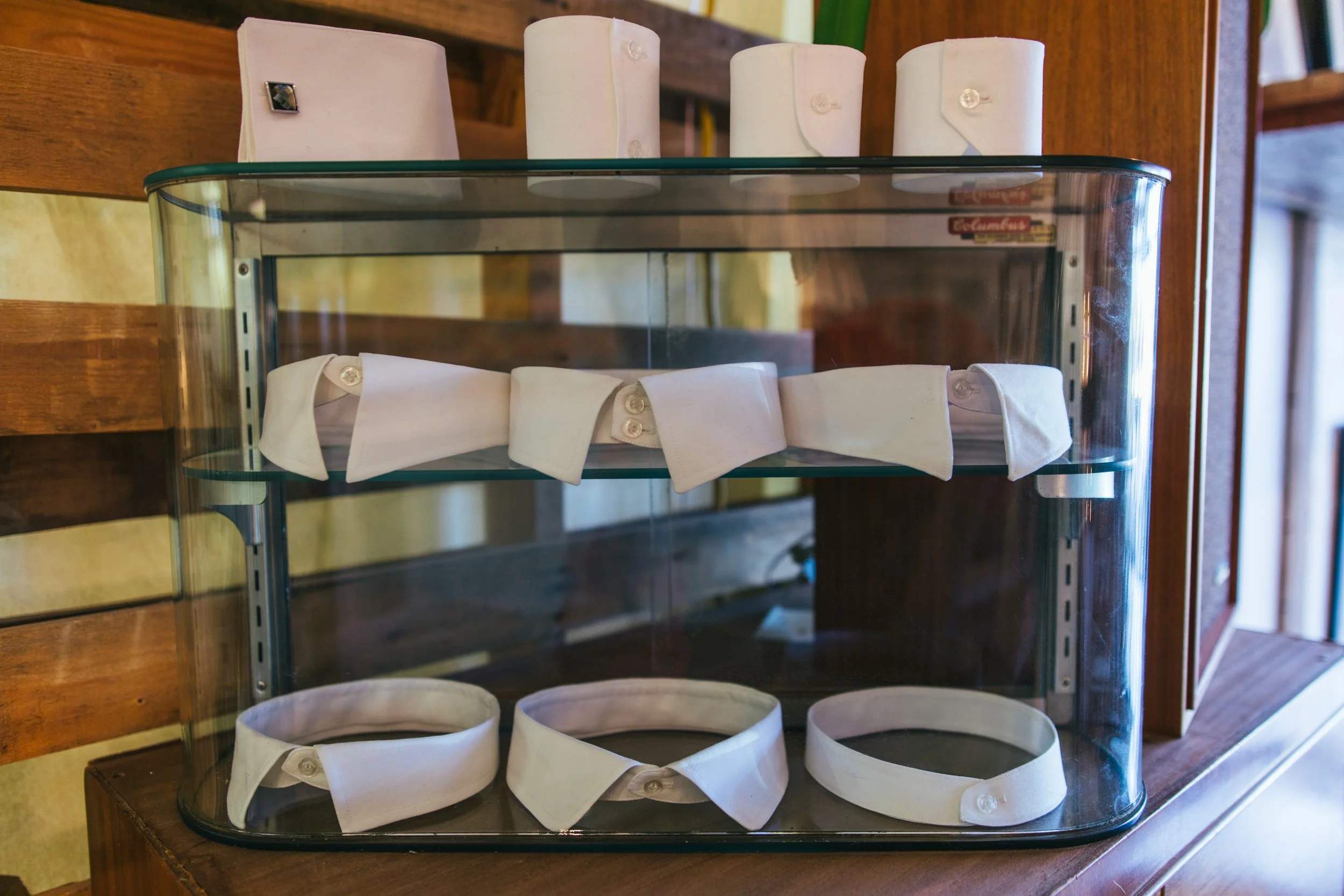
Bespoke shirt collar and cuff samples in the Philip Sparks studio
Collar Shapes
We spoke of a classic Kent collar whose points sit closer together, a Windsor collar with points spread far to accommodate a thick silk tie. We talked about rounded collars and button down too.
In classic shirts, we talked about the variety of cuff options: angled, rounded, barrel or French. We spoke about options and differences in front button plackets, whether that’s classic, folded, hidden or with contrasting details. We spoke of options for pleats on the sleeves and to breast pocket or not.

A take on a bib front pleated tuxedo shirt by Philip Sparks for the collection "White Collar Criminal, Fall 2008”
Tuxedo Shirts
We also spent some time discussing tuxedo shirts, including pique, a textured woven cloth often used on the bib or front of a tuxedo shirt and the cuffs. We showed examples of pleated front tuxedo shirts and then reflected on how most classic “men’s” jewellery is somehow associated with or attached to the shirt, be that shirt studs, cufflinks or tie bars. We talked about how this jewelry evolved from a need to remove buttons before washing as an old fashioned ringer washer would break them. We also spoke about removable collars, and how shirts were sold with multiples to make them last longer.
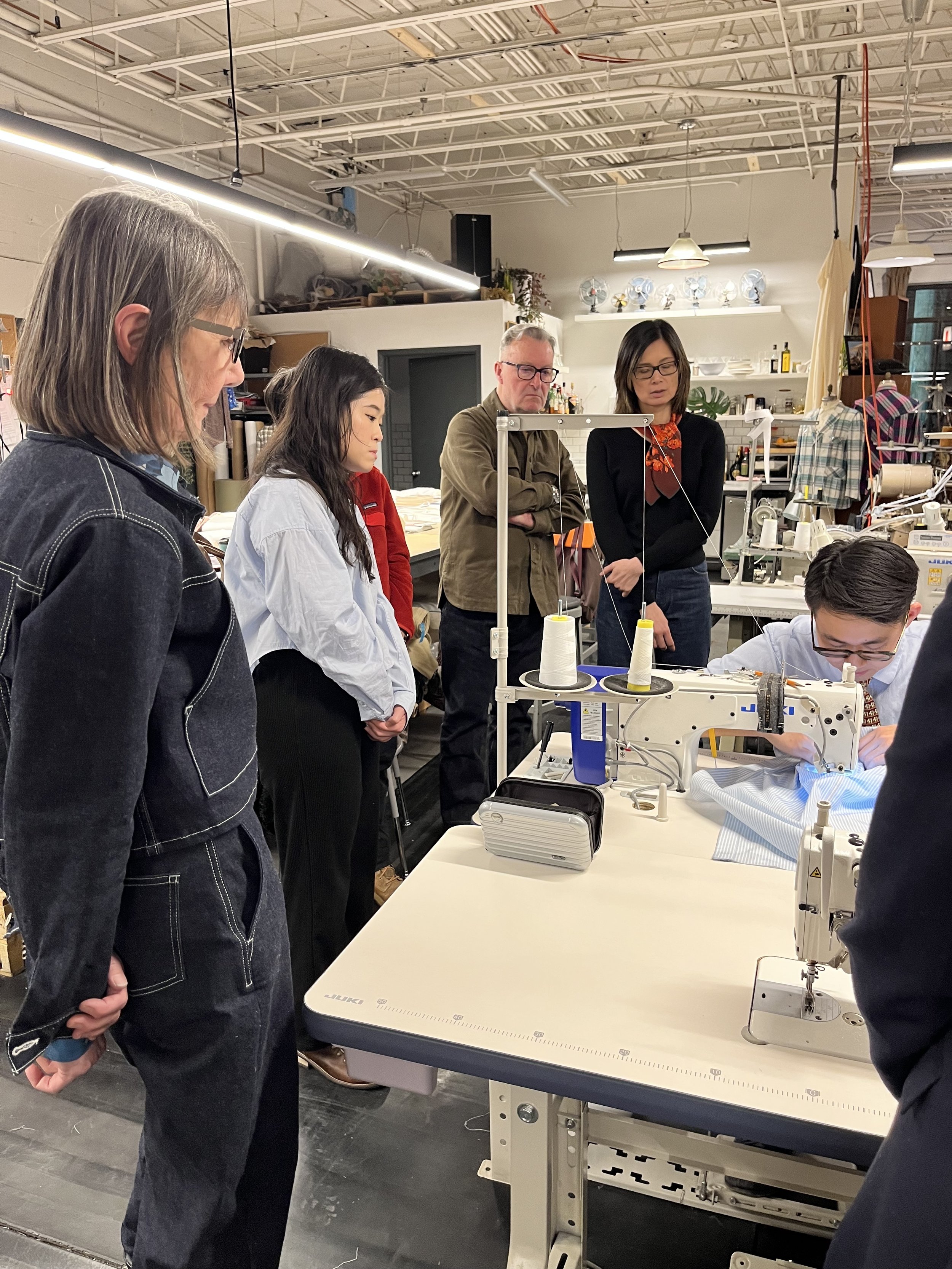
Takuma demonstrating bespoke shirt construction techniques in the Philip Sparks studio
Constructing bespoke shirts
Takuma gave a demo of sewing the sleeve placket and felling the underarm, a few of the unique construction techniques specific to shirts.
We had lots of other cloth types out to discuss including twill shirting, cotton poplin, seersucker and lots of stripes and plaids. I can’t even get into the mother of pearl buttons we discussed. That will have to be a separate post.
Interested in our custom shirting, book an appointment
From Shirt History to Bespoke Shirtmaking
Many of the details discussed here — collar shape, cuffs, plackets, proportions and fabric — are things that can be explored when a shirt is made specifically for an individual. At Philip Sparks Tailored Goods Inc., our bespoke shirts are individually drafted, fitted through a series of fittings and made in our Toronto studio. Explore our bespoke shirts in Toronto
